The problem
The platform ran four EKS clusters across five AWS accounts. Spend had grown by about 70% in four months, and nobody could say which part of it bought anything. Workloads asked for far more than they used: on every cluster, requested CPU was 7 to 20 times actual use, and about 40% of workloads had no requests at all. All four clusters were also on a Kubernetes version that had moved into paid extended support.
of workloads had no CPU requests at all
What Nuno did
Nuno measured before cutting: a cost baseline from twelve months of billing data, and a right-sizing dashboard that every engineer could read. Then Nuno removed what was paid for twice or not used at all, including a self-hosted metrics stack that duplicated the paid observability tool and an unused staging environment, which was decommissioned end to end. Nuno sized workloads from real usage and let the node autoscaler pack them onto fewer nodes, moved non-production and CI onto interruptible capacity, upgraded the clusters out of extended support, and cleaned up database sizing, backup retention, network and storage. Only after the baseline was lean did Nuno buy a one-year compute commitment for what remained.
- Step 1
Measure first
A cost baseline from twelve months of billing data and a right-sizing dashboard every engineer can read.
- Step 2
Remove what is paid twice
A duplicate metrics stack and an unused staging environment, taken down end to end.
- Step 3
Size from real usage
Workloads packed onto fewer nodes, interruptible capacity for non-production and CI, clusters out of extended support.
- Step 4
Commit, then hand over
A one-year commitment on the lean baseline, and a team session and checklist so the savings stay.
Making it stick
Savings that depend on one person come back. Nuno ran a session with the engineering team on sizing workloads from real data, gave them a short pre-merge checklist, and left the right-sizing dashboard as the shared reference, so new services can start with sensible requests.
What happened after
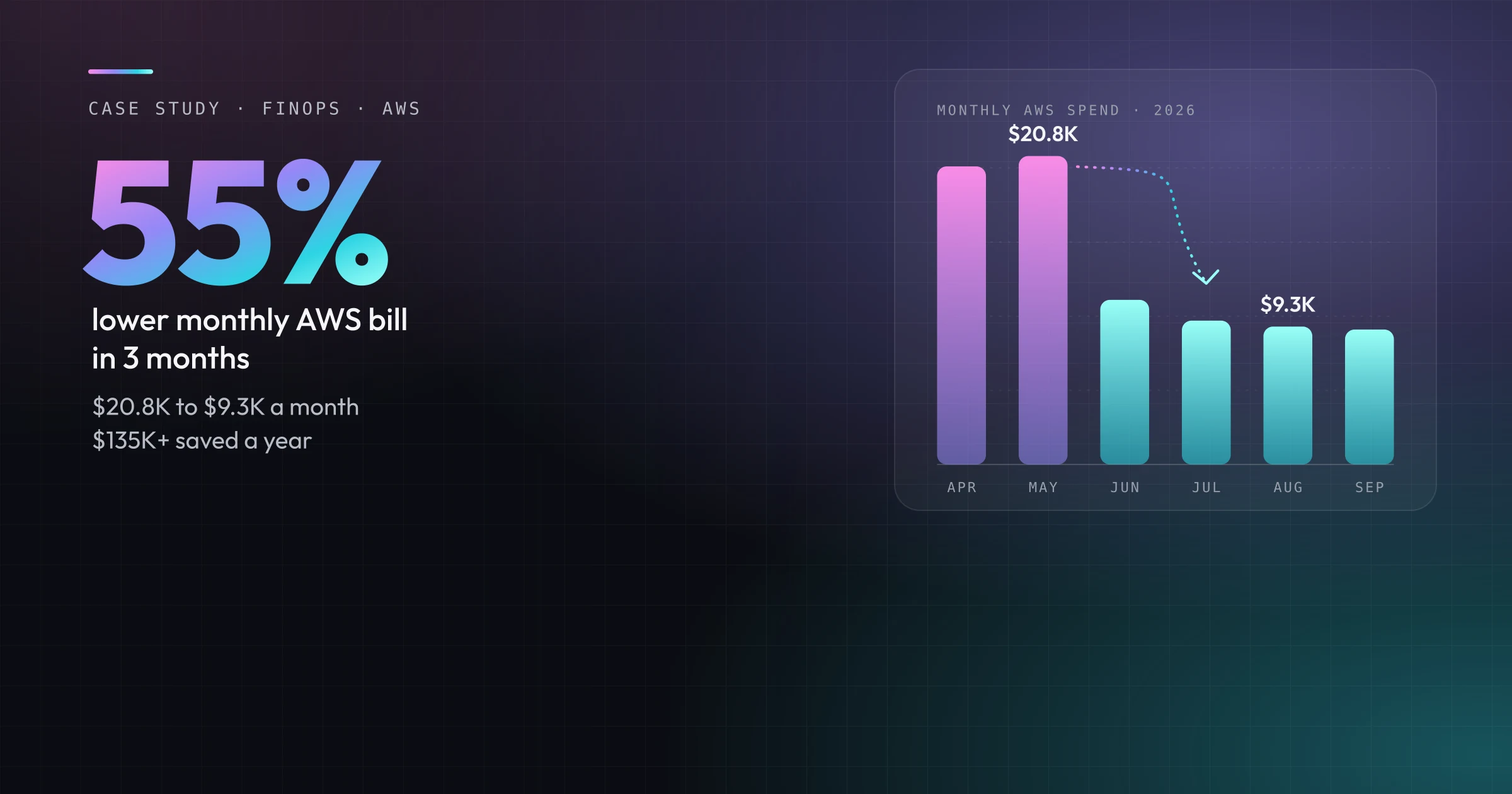
Spend fell 55% and held for four months. Then some of it was spent back on purpose. After a production incident linked to interruptible capacity, Nuno moved production off it. That costs about $1,000 a month and was the right trade for a customer-facing product. A new search cluster for a product feature was added in the same period. October spend is forecast at about $12,600, still around 40% below May.
Results
Monthly AWS spend fell from about $20,800 in May 2026 to about $9,300 in August, a 55% reduction and more than $135,000 a year, and stayed there in September. Removing the duplicate metrics stack saved about $2,500 to $3,000 a month, the staging teardown about $14,800 a year, and leaving extended support about $1,440 a month. In the autumn some of the savings went back into running production on regular capacity and into a new feature, and spend is still well below where it started.
Main Tools and Cloud-Native Solutions
Cost visibility
- Cost baseline built from twelve months of billing data.
- Right-sizing dashboard comparing requests with real usage for every workload.
Removing waste
- Duplicate self-hosted metrics stack removed.
- Unused staging environment decommissioned, with a final database snapshot kept.
- Database sizing, backup retention, network and storage cleanup.
Kubernetes efficiency
- Workloads sized from real usage, with the node autoscaler packing them onto fewer nodes.
- Interruptible capacity for non-production and CI.
- Clusters upgraded out of paid extended support.
Rates and habits
- One-year compute commitment sized to the leaner baseline.
- Team session, sizing checklist and shared dashboard so the savings do not depend on one person.