The problem
When Nuno started in May 2021 there had been no DevOps engineer before, and many AWS resources existed only in the console. Nobody could rebuild an environment from code, and every new region or environment meant repeating manual work. The team was growing fast, the product was expanding to more regions, and partners wanted proof that changes were controlled, backups were tested and access was limited. That proof is hard to give when the source of truth is a set of console screens.
What Nuno did
In May 2022 Nuno proposed an infrastructure-as-code standard to the company's architecture forum: immutable infrastructure, separate AWS accounts and environments, Terraform with Terragrunt, and every change through a merge request. The named risk was importing the legacy resources without breaking them, so they were brought into code before anything new was built on top. A month later the repository held 116 Terragrunt units across four AWS regions and four environments (development, staging, production and sandbox), with CI templates per region. The modules covered networking, databases, container services and registries, identity, customer encryption keys, queues and messaging, DynamoDB, AWS Config rules, API Gateway with Lambda, and data ingestion. Nuno also moved AWS access to single sign-on. Production ran behind a CDN and a web application firewall, with services in private subnets, an internal load balancer for service-to-service calls, outbound traffic only through NAT, and a Multi-AZ PostgreSQL database that only a few services could reach. From 2023 Nuno added Kubernetes next to ECS and moved CI runners onto the cluster, and by 2025 the platform ran on EKS with Karpenter node pools on Amazon Linux 2023, including a dedicated pool for CI runners.
Compliance and recovery
Nuno led the company's first SOC 2 and the renewals after it, 3 to 4 years in a row, and produced the infrastructure controls and their evidence: backup policy, database retention, network tiers, access, change management and secrets handling. Backups were driven by tags, so a resource got the right retention by declaring which plan it belonged to. Kubernetes secrets were first encrypted with SOPS and AWS KMS, and later moved to Sealed Secrets. Production deploys were limited to protected CI environments, and capacity changes went through infrastructure-as-code merge requests. Nuno rewrote the disaster recovery procedure around Terraform and tested redeploying the Kubernetes tooling and infrastructure from code.
Cost grew with the business
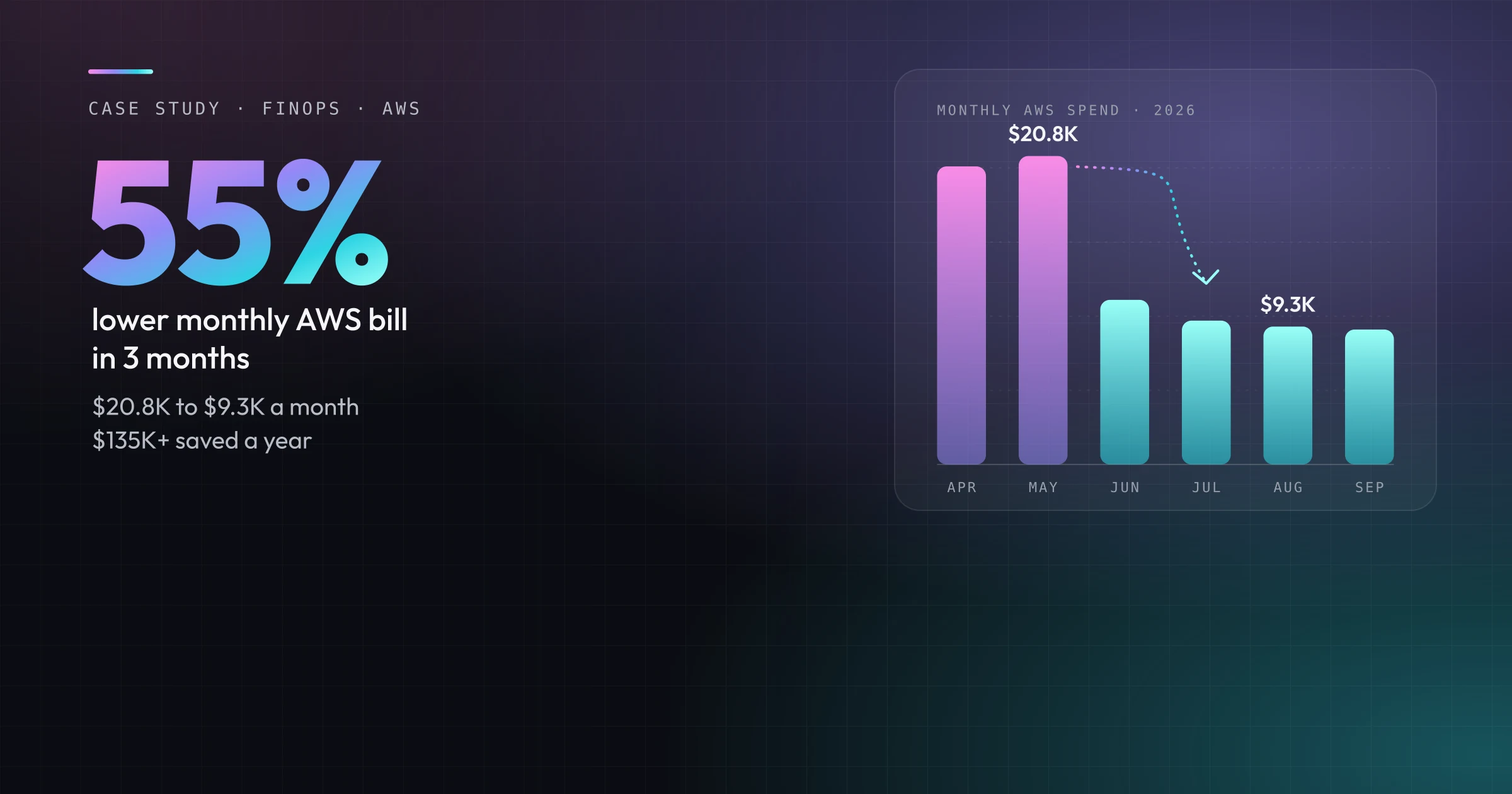
The AWS bill grew from a few thousand dollars a month in 2021 to over $60,000 a month as the business grew. A cost program led by Nuno brought it down to about $46,000 a month in 2023. After that the bill stayed near $60,000 a month while transaction volume kept growing. A later review of six months of the bill, in early 2025, still showed costs nobody had chosen on purpose: CloudWatch log ingestion that grew about four times in two months, older gp2 volumes that cost more each month than the gp3 volumes next to them, AWS Config recording in staging that rose about nineteen times, and an always-on SFTP endpoint at more than a thousand dollars a month. Infrastructure as code makes resources visible and repeatable, but it does not tell you what they cost. That needs its own regular review.
Cost per transaction
A total bill only tells leadership that spend went up. Nuno built a Grafana billing dashboard on CloudWatch billing data that divided month-to-date AWS spend by the number of transactions, so the VPs could see where they stood in one number. In October 2025 it showed about 1.03 million transactions for the month so far and about 5 cents of AWS spend per transaction.
Results
By June 2022, a year after Nuno started, the platform was described in 116 Terragrunt units across four AWS regions. A 2022 internal review put the time to deploy infrastructure 70% lower. The company obtained its first SOC 2 and kept it for 3 to 4 consecutive years. The AWS bill grew from a few thousand dollars a month in 2021 to over $60,000 a month with the business, the cost program brought it down to about $46,000 a month in 2023, and it then held near $60,000 while volume grew past 1 million transactions a month. In November 2023, 56 synthetic monitors watched the platform. By October 2025 the platform processed about 1 million transactions a month at roughly 5 cents of AWS spend per transaction.
Solutions
Infrastructure as code
- Terraform and Terragrunt standard adopted through the architecture forum in 2022.
- Legacy console resources imported into code before new work was built on top.
- 116 units across four AWS regions and four environments by June 2022, with CI templates per region.
Platform
- Multi-account AWS setup with single sign-on for access.
- Private subnets, internal load balancer, outbound traffic only through NAT, database reachable by a few services only.
- Kubernetes next to ECS, then EKS with Karpenter node pools and CI runners on the cluster.
Reliability and compliance
- 56 synthetic monitors covering HTTP endpoints, ports, databases and DNS.
- Tag-driven AWS Backup plans and 35-day database backup retention.
- Kubernetes secrets encrypted in Git, first with SOPS and AWS KMS, later with Sealed Secrets.
- Disaster recovery procedure based on Terraform, with a tested redeploy from code.
- First SOC 2 for the company, kept for 3 to 4 consecutive years.
Cost
- Monthly AWS spend brought down from over $60,000 to between $45,000 and $50,000.
- Regular service-by-service reviews of the bill.
- Grafana billing dashboard showing AWS spend per transaction, about 5 cents in October 2025.